COLD WAR

OPERATION HURRICANE

November 18, 2025

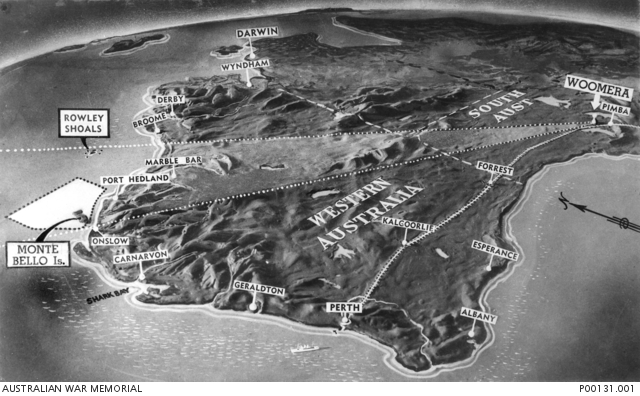
The circumstances surrounding the British atomic tests which took place in 1952 on the Monte Bello Islands, 130km off Western Australia’s Pilbara coast remain extraordinary, even with the passage of more than 60 years. This episode of the podcast is an interview with the fantastic Paul Grace, author of ‘Operation Hurricane: The Story of Britain’s First Atomic Test in Australia and the legacy that remains’. Paul has a unique connection to the tests, his Grandfather was a RAAF pilot who flew ‘coastal monitoring sorties’ in the radioactive aftermath of the tests searching for fallout on the Australian mainland.

Listen to the story and my discussion with Paul Grace here at Apple Podcasts also available at Spotify and Audible:

WORLD WAR 2

BICKLEY POINT BATTERY – An Introduction…

October 27, 2025

Bickley Point on Western Australia’s Rottnest Island was the location of two 6 inch coastal defence guns. Its role was as a close defence battery to prevent enemy ships passing through the strategic ‘South Passage’ between Rottnest and Carnac Island to attack Fremantle. It had a secondary role as an ‘Examination Battery’ for the challenging and identification of ships entering Gage Roads. It became operational in 1939 and was an important part of the Fremantle Coastal Defence Fortress.

A remnant of the battery sits today at nearby Kingstown Barracks. The barrel of gun Number 2309, manufacted at the Royal Ordnance Factory, Leeds, which was once part of the armament of the Chatham Class Cruiser HMAS Melbourne.

There is more to come on the Bickley Point Battery, to know more about the ‘Rotto Guns’ you can listen to the story here:

WORLD WAR 2

Italian L3/33 ‘Tankette’ (Carro Veloce CV.33)

October 2, 2025

The Italian ‘Carro Veloce CV.33’ was a 2 person mini-tank used in every theatre the Italian Army (Regio Esercito) fought before and during World War 2. While successful during the Italo-Abyssinian War and Spanish Civil War its light armour and armament made it unsuited to modern combat and it was primarily used for reconnaisance and supply (towing cargo) It weighed approximately 3,000KG, had a top speed of 41km per hour and was armed with twin machine guns (Ususally Fiat-Revelli Modello 35) operated by a gunner on the left, with a driver on the right.

The below (colour) example was captured in North Africa, likely by British troops and sent to England for evaluation. It was then shipped to Canada and is now on loan from the Canadian War Museum to the Australian War Memorial (AWM) in Canberra. It’s painted in the ‘Ram’s Head’ livery of the 132nd Armoured Division ‘Ariete’. (‘Ariete’ refers to ‘Aires’ the Ram star constellation) This division was destroyed at the Second Battle of El Alamein.

WORLD WAR 2

ITALIAN BREDA CANNON IN AUSTRALIAN SERVICE

September 20, 2025

I recently took a trip to Canberra and visited the Australian War Memorial. One of the displays that impressed me was the captured Italian Anti-Aircraft cannon mounted on a Chevrolet truck.

The piece in question is a Breda 20mm Model 1935 anti-aircraft gun. These were captured in such large numbers in North Africa that they were used to equip Australia, British and some Free French units.

Fed by trays of 12 shells, the captured Breda’s were used in an anti-aircraft or ground support role. They could be fixed in position or mobile and mounted on trucks by units such as the Australian 3rd Light Anti-Aircraft Regiment and the British Long Range Desert Group (LRDG).

They were used widely by Italian and German forces and interestingly also mounted by Italy’s equivalent to the LRDG, the Auto – Saharan Companies (Compagnie Auto-Avio-Sahariane).

Contact between these two units was described as ‘The First Clash of Special Forces’ by Kuno Gross and Robert Chiavaretto. In January 1941 in southeastern Libya, the British LRDG were intercepted by the an Auto-Saharan unit in the Gebel Sherif valley.

“The enemy (Italians) who were forty-four strong in two armoured fighting vehicles and five trucks had the advantage of close co-operation with aircraft and of being armed with Breda guns (Auto-avio sahariana)”

— Ambush at Jebel Sherif – Official History of New Zealand in the Second World War 1939-45.

GENERAL (as 'generic' not 'rank')

MURDER ON THE DANCEFLOOR: THE TRIAL OF AUDREY JACOB, 1925

September 1, 2025

I know the title injects some whimsy into what is ultimately a sad and tragic tale but it’s such a banging track that I couldn’t resist.

The story is incredible and as it will soon be be brought to life in the form of a play ‘Arthur Haynes and the Smoking Gun’ at Government House this September, I thought it time to revisit the subject.

Below is the opening paragraph of Perth’s Mirror Newspaper from Saturday 29th of August 1925:

“Perth’s greatest ballroom shone brilliant with light and gaiety on Wednesday night when hundreds of glad hearted boys and girls and their elders danced and made merry to aid the benevolence of the hospital of St John of God. They had chased the glowing hours with flying feet and the grand ball was drawing to a happy close, the night had passed into early morn. It was one of those scenes on which the high Gods seemed to smile. Then a shot, hushed chatter, little startled cries, a scatter of dancers, a girl with a revolver and a young man with a blood smeared face dying on the floor. The High Gods had deserted their chosen. Terror was upon the gay hall. Mirth fled away into the shadows. The Glory of the lights and the gaiety of the colours and the music and the laughter gave way to the awe that beckoned the presence of the Dreadful great. King Death had entered in….’

The article recounted the story of two days prior, during the St John of God charity ball at Perth’s Government House, where, in front of hundreds of witnesses, a young man, Mr Cyril Gidley, was shot in the chest at point blank range and died.

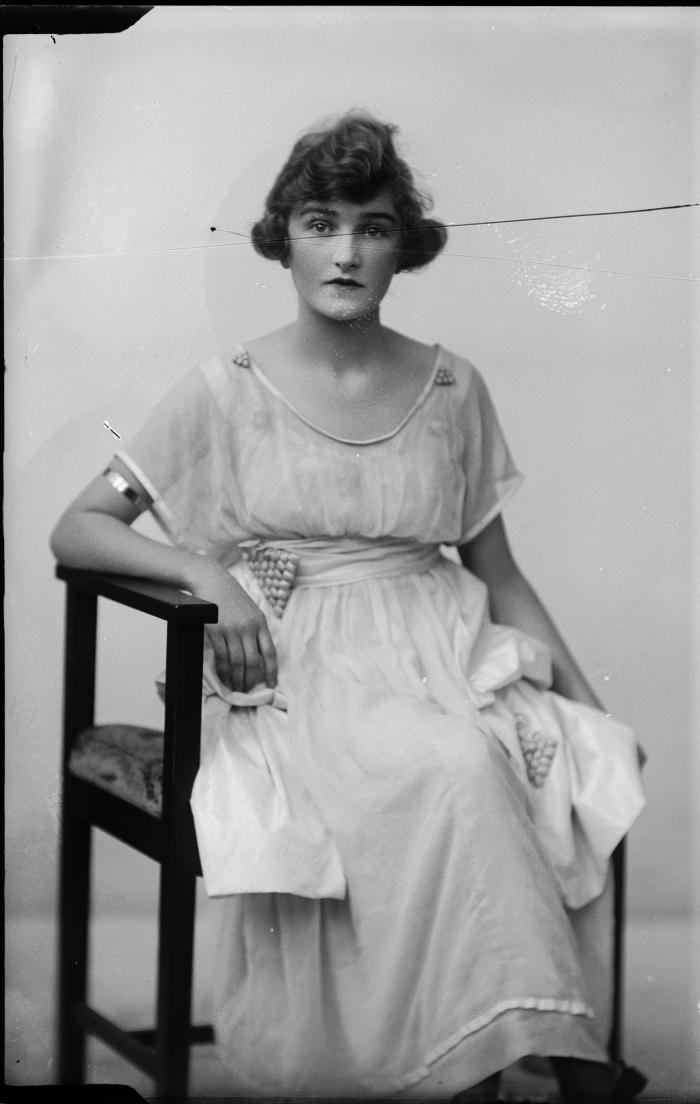
The killer was his 20 year old former fiancé Audrey Jacob. She stood, holding a pistol and according to witnesses, said “I did it”, before being led away by police. What should’ve been an open and shut case became a legal and media sensation and led to Jacob’s acquittal for murder.

The trial was held at the Perth Courthouse on the 8th October 1925 where before Justice Northmore, Jacob plead not guilty to the charge of wilful murder. The story told in the papers, came largely from the argument presented by the defendant, her mother and her defence lawyer Arthur Haynes who by all accounts was the Johnny Cochrane or Jackie Chiles of his day.

Their version was that the victim Cyril Gidley, was not the victim at all, but had been a violent and emotionally abusive man. A man that seduced Jacob then callously ended their engagement breaking her heart. Furthermore the shooting was an accident!

The story presented to the court was Jacob attended the annual St John of God Ball in Perth with a friend, Miss Annie Humphreys. She encountered her ex-fiancee on the ballroom floor, wickedly dancing with another woman. There was an altercation during which she pleaded with him to take her back which he refused.

She then returned home distraught, to kill herself. She took a revolver, (we’ll leave aside the issue of what this respectable 20 year old woman is doing with a revolver) but she takes said revolver and walks to the river to take her own life. She then has a change of heart and walks to a nearby church, says a Rosary and then returns to the ballroom to see if her prayers will be answered and make one last effort at reconciliation. But she is scorned once again. Overcome with grief, she gets a headache, and having forgotten she was still carrying the gun in a white handkerchief, puts her hand to her head and the revolver accidentally goes off.

This is a series of events which proved compelling to a jury despite a number discrepancies such as when asked by the prosecution to replicate wrapping the gun in a white handkerchief, she couldn’t do it, and furthermore no handkerchief was found at the scene.

Spoiler alert, the next day Audrey Jacob was acquitted of the murder of Cyril Gidley. What was extremely powerful in shaping the narrative was the role of the media in pushing the evil man, woman scorned story. Jacobs lawyers notes have been examined in detail by Caroline Ingram, a PhD candidate in history at the University of Western Australia. It seems that Arthur Haynes worked very hard to ensure the ‘right’ story was in the newspaper reports and the right story was to show Jacob as a respectable, demur and innocent woman.

Audrey Jacob would’ve been only about 18 when she met Cyril Gidley, who was five years older than her. Her father was the clerk of the courts at Fremantle and she was one of eight children. They lived in a cramped worker’s cottage and struggled to make ends meet.

Her father seemed to be a bit of a cad. It was reported that he would regularly flirt and make advances towards women coming into the court seeking divorce. There at least one case of an irate husband taking umbrage and physically assaulting him. In 1924 Ms Jacob’s mother Jessie took out a court order against her husband for cruelty and he was ejected from the family home for a period. These family details didn’t serve the wholesome narrative and was suppressed during the inquest and the trial.

The dead man Cyril Gidley served as an engineer on the WA State Ship ‘Kangaroo’ (sister ship to the ‘Koolama’) he had only been in WA for about two years and was originally from the UK. He had no family and few friends here, which was significant to the case as there was no one to push a counter-narrative and defend him in the public eye.  At the inquest a few weeks after the murder, Jacob’s mother, gave evidence, which was reported in The Sunday Times on the 6th of September that Gidley was abusive and cruel towards her daughter and had threatened the life of her husband.

Evidence given at trial further pushed the narrative of Gidley as a rake and serial jilter of women with a collection of engagement rings, and a number of alleged violent incidents to his name including a suggestion that he had sexually assaulted Jacob. Most of these assertions came from Jacob and her mother.

The defence lawyer Arthur Haynes appeared to have spent a considerable amount of time cultivating The Mirror newspaper where he was not only a friend of the owner, but also regularly employed by them. It’s suggested that he helped craft many of the negative articles about the deceased.

The family of Cyril Gidley’s, lived a world away in the town of Grimsby on England’s north-east coast. They did not attend the trial and little evidence emerged to defend his character. There were people who owned lodging houses where Cyril had stayed, and they described him as being a gentleman and were surprised at what was stated in the trial.

There was evidence, not presented at the trial or published in the media that his life might’ve previously been threatened by Jacob. Two weeks before the murder, Gidley wrote a note stating that Jacobs had visited him on his ship at Fremantle and “threatened me with my life if I didn’t make her my friend again”. He had also written a will a few months earlier. It’s considered that the threats began when he first broke off their engagement in early 1925.

In addition to attacking the character of Gidley, Haynes’s final legal tactic, used at the end of the trial, was to bring up a concept known as the “unwritten law”. The judge reminded the court that it was NOT a law but it was a powerful cultural concept at the time.

The ‘Unwritten Law’ was basically an understanding that a respectable woman who had been seduced and abandoned or jilted by their fiancé or lover had the right to take revenge. The ‘unwritten law’ had never achieved a full acquittal in Australia before. This was the first and possibly the only time that it was used successfully in a defence.

So the story in summary is, poor innocent, respectable girl, defends herself and takes revenge on the cruel, callous, cad that cast her aside and ruined her. The jury was convinced and the verdict…….not guilty. When the verdict was read out, the newspapers reported there was applause and cheers from the public gallery.

After her acquittal, Jacob left WA, travelled to Melbourne and met a wealthy American whom she married and left Australia disappearing from public view. According to Senior Archivist at the State Records office of Western Australia Damien Hassan, they had a daughter who subsequently went to work for US intelligence during the Cuban Missile Crisis.

You can find out more, see details, images and exhibits from the trial, including the bullet which killed Cyril Gidley at the Old Courthouse Law Museum in Perth. Or you can see the story performed on stage! The play ‘Arthur Haynes and the Smoking Gun’ will be performed at the very Government House where the heinous act took place from September 11-13, 2025.

(Image copyrights TROVE, The Old Courthouse Law Museum and James De Leo)

Uncategorized

A visit to the Oliver Hill Battery

August 27, 2025

A jewel in the crown of the dramatically named Fremantle Coastal Defence Fortress was the two 9.2 inch naval guns, H1 and H2 situated at Oliver Hill on Rottnest Island (Wadjemup). These guns were originally intended to be emplaced at Mosman Park on the mainland but this position wouldn’t prevent the bombardment of Fremantle by enemy warships, therefore they had to be placed further out to sea. The gun pictured here (H1) weighs 30 tonnes and before finding its way to Western Australia it was originally supplied to the Royal Navy for fleet use in Hong Kong.

Listen to the podcast at Apple podcasts, Spotify and Audible.

PRE-FEDERATION

LAND OF THE EENDRACHT: DIRK HARTOG, 1616

July 23, 2025

DEN 25 OCTOBER IS HIER AEN GECOMEN HET SCHIP DEENDRAGHT VAN AMSTERDAM
DE OPPERKOPMAN GILLIS MIBAIS VAN LVIK SCHIPPER DIRCK HATICHS VAN AMSTERDAM
DEN 27 DITO TE SEIL GEGHM NA BANTVM DE ONDERKOPMAN JAN STINS
DE OPPERSTVIERMAN PIETER DOOKES VAN BIL ANNO 1616

“On the 25th October the ship Eendracht of Amsterdam arrived here. Upper merchant Gilles Miebais of Luick [Liege]; skipper Dirck Hatichs [Dirk Hartog] of Amsterdam. On the 27th October we sail for Bantum. Under merchant Jan Stins; upper steerman Pieter Doores of Bil [Brielle]. In the year 1616.”

“Dirk Hartog is an island off the West coast of Australia. In the language of the local Malgana people it’s called Wirrumana. It’s historically significant as the place where the oldest European artifact was found on the Australian continent. So……..suck it New South Wales.

Dirk Hartog was a 17th century sailor, merchant and explorer. The Dutch feature prominently in the exploratory, cartographic and……namefication history of Western Australia.  Alas all they left were some place names, shipwrecks and kitchenware.

So who was he? We don’t know his precise birthdate but he was likely born in 1583. His name is the patronymic ‘Hartogsoon’ literally meaning ‘Hartogs son’, there are many different spellings of his name and while Dirk Hartog is technically incorrect it is the most common spelling found.  He was raised in a nautical family and went to sea as a young man. In 1611 he purchased a small ship Dolfin and traded around the Mediterranean and Baltic with his first contract taking him to Dunkirk to collect 280 tonnes of French salt. In 1615 he was appointed Captain of the 700 tonne ship Eendracht, meaning ‘Concord’ or ‘Unity.’ This was a common name given to Dutch ships around this time, as it came from the motto of the Dutch republic in Latin: ‘Concordia res parvae crescent’ and Dutch ‘Eendracht maakt macht’ / “Unity makes strength”. It carried a crew of 200 men and 32 cannon. It was part of the fleet belonging to the United East India Company or VOC. VOC stands for Vereenigde OostIndische Compagnie (Henceforth I’ll refer to it as VOC or the ‘Company’. It was formed in 1602 and was the world’s first multi-national conglomerate. It came about because the merchant cities of Holland would individually send ships to the Far East with no collaboration or coordination. The government, the Staten Generaal, intervened in 1602 and forced all the companies to merge into one and granted them a 21 year trade monopoly, the power to wage war and to establish colonies with the aim of wresting the spice trade from the Portuguese.

This was the beginning of the Dutch Golden Age. Dutch poet Joost Van Den Vondel wrote in 1639:

“…wherever profit leads us, to every sea and shore; for love of gain the wide world’s harbours we explore …”

As Captain of a company ship, he was a man of gravity and importance. VOC ships had both a Captain and a Senior Merchant aboard. Put simply, the Captain handled the sailing and the Merchant handed the business and made sure the journey was profitable. But the reason for being of the VOC was profit, so the Senior Merchant outranked the Captain in decision making. When ships left Holland they usually carried a fortune in silver and gold not only to pay wages and keep the Indonesian colonies functioning, but to purchase the most valuable of commodities at the time; spice. This was Pepper, Cloves, Nutmeg, Mace, Cinnamon as well as silks, cotton and porcelain.

On 23 January 1616, Hartog set sail from the island of Texel in the Netherlands with 2 ships later joining with 2 more. The typical route to the East Indies was down the Atlantic coast of Africa, stopping along the way as required for water, food, repairs, etc.

Eendracht became separated from the rest of the fleet. After reaching the southern tip of Africa, Hartog rounded the Cape of Good Hope and travelled East across the Indian Ocean.

They were assisted in this by plugging into a strong wind called the ‘Roaring 40s’. 

This route, pioneered in 1609 by another company Captain Hendrik Brouwer used the prevailing winds between latitudes 35 and 45 degrees south to speed up sailing times from Holland. Sometimes before their turn North to Indonesia, they would be blown too far East. This is how he any many of his VOC colleagues including the ship Leeuwin encountered Western Australia, part of the ‘Unknown South Land.’ referred to as ‘Terra Australis Incognita’.  

The Eendracht found themselves on the wild Australian coast when they arrived at Shark Bay on the 25th October 1616 and anchored at the Northern tip of a long thin island. The crew went ashore and explored for two or three days. The land was considered inhospitable and of no use to the VOC, certainly nothing to distract from the untold riches of the East Indies. After all the Dutch were traders not land developers.

To mark their visit, the crew flattened a pewter dinner plate and  engraved it with the details of the ship and crew. This is called ‘Hartogs Plate’ and it is now preserved in the Rijksmuseum in Amsterdam. The plate is the earliest archaeological evidence of a European presence in Australia and the place where it was found at the north-western tip of the Island forms the western edge of Shark Bay and is known as ‘Cape Inscription’. Leaving carved plates, stones or boards was part of a maritime communication system used by Dutch seafarers.

Hartog called the lands he encountered Eendrachtsland (Land of Eendracht) That name was recorded in the archives and was used by VOC cartographer Hessel Gerritszoon on his famous map of the West Coast of Australia.

The Eendracht then continued North sailing into the Flores Sea off Indonesia. Meeting a hostile reception at Makassar on the island of Sulawesi, Eendracht arrived at its destination the important spice trading port of Bantam, Java. It was then active in regional trade, for example in September 1617 shipping to Bantam 200 tonnes of Cloves.  Almost a year later on 17 December 1617, Eendracht departed for the voyage back to Holland likely with a load of spice and trade goods arriving in the Dutch Province of Zeeland in October 1618. Hartog then faded into obscurity, he left the VOC shortly after and worked private trading ventures until he passed away a few years later.

Hartog’s plate remained undisturbed for 81 years until another Dutch Captain Willem de Vlamingh came ashore in 1697 and found it degraded and half buried in sand. He made a new one, copying Hartog’s inscription then adding the details of his own visit. He returned to the Netherlands with the original plate, which now resides in Amsterdam.

I’ve talked about the French Baudin scientific expedition before, in particular the journeys of the ships Geographe and Naturaliste. In 1801 they too landed on the Island. The De Vlamingh plate was found by young cartographer, Louis de Freycinet, who bought it back to the Naturaliste. Captain Jacques Hamelin, ordered him to return the plate to where he found it.  You can listen to the story of the Naturaliste and Geographe at www.backyardbattlefields.com (Where you are right now!)  In 1818 de Freycinet returned, this time a Captain of his own ship L’Uranie, he’d obviously been thinking about the plate for the past 17 years and took it back to France as a souvenir. It then disappeared until the 1940s where after the Second World War, it was found and  gifted to the Australian government. The plate now resides at the Maritime Museum in Fremantle, Western Australia.

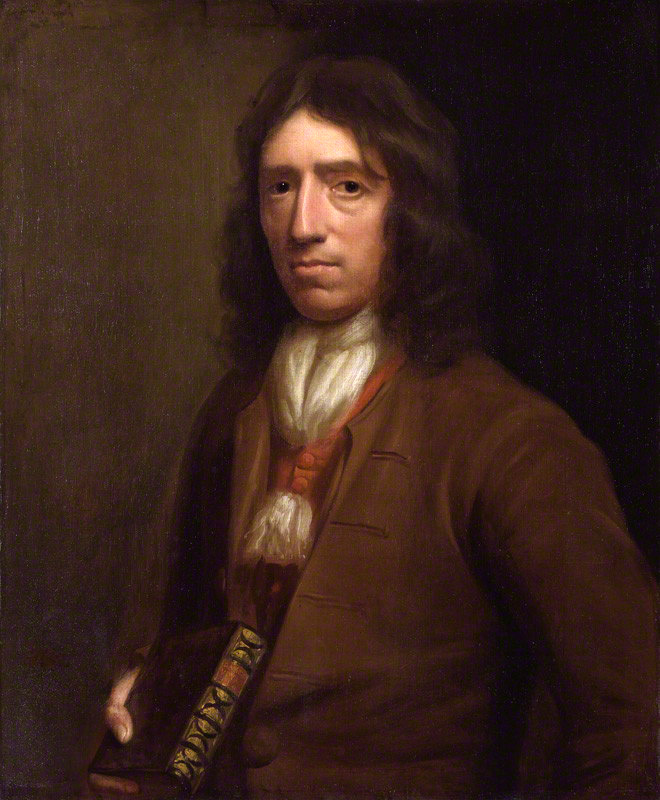
Many other sailors also spent time in the area around Dirk Hartog Island including explorer, travel writer and Avocado fancier Englishman William Dampier who arrived in 1699 during his voyage to explore and map the coasts of ‘New Holland’. Due to the large number of Sharks he saw, he named the surrounding waters ‘Shark Bay’, he spent a week mapping the coast and collecting plant specimens.

In 1772 a Frenchman with the impressive name Louis Francois Marie Aleno de Saint Aloüarn aboard the ship Gros Ventre arrived on a mission of exploration and acquisition with the goal of claiming the western half of ‘New Holland’ for King Louis XV. On the evening of 29th March, Gros Ventre entered Shark Bay. The ship’s boat went ashore with some crew and five soldiers to reconnoitre the land and claim possession for the glory of France. After walking inland, finding little evidence of human occupation, they returned to the coast and took possession of the land.

A Prise de Possession took place on a cliff on the Northern part of the Island, overlooking a place called Turtle Bay. The annexation was commemorated by raising a flag, firing a volley of rifle shots called a Fuer de Joie and reading a proclamation which was then inserted into a bottle, sealed with lead and buried. Near it they placed two six franc coins. It wasn’t until 1998 that the coins and lead seals as well as one bottle were recovered.

Fifty years later, Englishman Phillip Parker King, also made his mark on the island, not only inscribing his initials and the year 1822 on one of the remaining Dutch posts but he also cemented his place in Australian bogan folklore by lending his ships name, the Bathurst to their beloved motor race.

With the multiple Dutch and French visits to Western Australia, significantly pre-dating the English, It’s always an interesting counter-factual to think about how close Australia came to becoming a partioned country like Canada, effectively half French half English or indeed half-Dutch. Think of it, instead of cheering for Daniel Ricciardo we’d be screaming Verstappen.

I shudder to think…………..”

Listen to this Backyard Battlefields episode at Audible, Apple Podcasts and Audible.

PRE-FEDERATION

‘EMILY TAYLOR & THE FOUNDING OF AUGUSTA, 1830’ (EPISODE 56)

July 7, 2025

The ‘Emily Taylor’ was a 200 tonne Brig built in the Bombay shipyards for the commercial and military powerhouse the ‘British East India Company’. Launched as the ‘Antelope’ it carried 12 guns and in addition to being a troop transport, carried trade goods such as spices, Opium, textiles and silks.

It was later sold off and acquired by a private company Robert Taylor and Co. and renamed ‘Emily Taylor’ after the proprietors wife. It sailed to Western Australia and in 1830 was chartered by the colonial governement to transport settlers, including members of the Bussell and Molloy families, to Cape Leeuwin to establish WA’s third settlement, Augusta.

On the return journey to Fremantle ‘Emily Taylor’ was blown ashore in a gale and wrecked. It is considered it carried the first Chinese ‘migrant’ to Western Australia, a (likely) Cantonese man called ‘Moon Chow’ (also known as Chow Moon) He was the ships carpenter and found himself stranded when ‘Emily Taylor’ was wrecked. He was a skilled tradesman, joiner and boat builder and his talents were highly prized in the young colony. There is romantic speculation that Moon Chow, was the first to manufacture and sell dumplings in WA. This theory was fueled by a court case where a leg of pork was stolen from his home. Tragically in 1877, Moon Chow was killed when he was struck by a horse drawn mail cart on Fremantles High Street, close to where the Orient Hotel stands today. His death led to the first road rules in Western Australia including speed limits and the requirement to carry lights at night.

Listen to this episode of Backyard Battlefields at Apple Podcasts, Audible and Spotify…..

Uncategorized

KIMBERLEY INCURSION: JAPANESE LANDING 1944

February 13, 2025

The ‘Hiyoshi Maru’ which carried the ‘Matsu Kikan’ Intelligence unit to Western Australia ( SOURCE: NAVAL HISTORICAL SOCIETY OF AUSTRALIA)

By the end of 1943, Japan was getting pushed back. It’s bases were getting overrun, it’s carriers sunk and it’s defensive positions across the Dutch East Indies were breaking up. Ongoing Allied offensives, on islands close to Australia including Timor, were beginning to take their toll. Put simply the Japanese were losing the war. The Dutch East Indies, present day Indonesia, were one of the crown jewels of the Japanese conquest providing raw materials and resources like rubber and oil.

The capital of West Timor, Kupang, was only about 800KM North of Darwin. It the homebase of some specialised Japanese intelligence units such as the ‘Kempeitai’, Military Police Corps, Tokkeitai Naval Secret Police and combined Military Intelligence agencies called KIKAN. The head of one of the Kikan units was career military intelligence officer, Captain Masanobu Yamamoto.

Yamamoto’s Unit was named ‘Matsu’ meaning ‘Pine Tree’ because pine trees symbolised longevity in Japanese culture. It was a small, joint Army-Navy group, specialising in localised reconnaissance. Controlled administratively by the Ambon-based Japanese Second Area Army, their parent unit ran out of the Tokyo-based Second Bureau Headquarters. Considered a reserve force, and basically second rate the Second Area Army was close to the bottom of Japan’s operational pecking order. However within the Second Bureau Army, Navy and Foreign Intelligence units were given priority.

Yamamoto’s unit consisted of himself, along with two fellow veterans of the Sino-Japanese War. Lieutenant Suzuhiko Mizuno and Sergeant Shinobu Furuhashi the fourth member was wireless operator Lance Corporal Kazuo Ito, a fresh arrival from the Taiwan battlefront.

BY the time World War 2 officially broke out Japan had been at war in Manchuria since 1931 and in China since 1937. Yamamoto and his colleagues were all graduates of the benign sounding ‘Army Correspondence Research Centre’ the cover name for Japan’s Nakano School of Intelligence. This was essentially a spy and unconventional warfare school. It taught counterintelligence, sabotage, foreign languages, martial arts and Guerilla warfare among other skills. Nakano trained Japanese paratroopers helped capture intact the Dutch oil facilities at Palembang and were active in the Burma, India and Okinawan campaign.

By end of 1943, leading Japanese strategists had already dismissed as any invasion of North Western Australian as just too difficult. However the ability of allied long range bombers to operate out of Northern airstrips and threaten Japan’s entire Southern defence perimeter was concerning. Japanese intelligence had some knowledge about Northern airstrips like the remote Drysdale Airfield but were concerned there were other airbases being constructed. With an absence of any hard in-country information on the matter, the Japanese needed reconnaissance. In January 1944, that task fell to Yamamoto’s ‘Matsu Kikan’ Unit.

The mission was planned using captured Allied charts and Japanese pearling maps. The sailing route was South across the Timor Sea, towards the rocky coral outcrops of the Ashmore Reef, and then on to Browse Island for initial observations. Landfall on the Australian continent was to be made a day or so later. The team were to visually record everything they saw and so took with them eight-millimetre film and cameras.

On the evening of the 14 January 1944 the Reconnaissance team left Koepang, in Timor we believe on board a 25 ton fishing vessel called “Hiyoshi Maru”. This was a former civilian coastal carrier requisitioned in December 1941 and converted into an gunboat fitted with machine and anti-submarine guns. Since early 1942, it had been under command of Lieutenant Tazaki Sueo, a highly experienced small boat officer. He and this vessel had already been involved in a variety of Japanese special operations, mostly in and around the Eastern fringes of the Dutch East Indies. (End ocean sounds here)

The team included Lieutenant Susuhiko Mizuno, 2 Sergeants, a radio operator, 6 sailors and 15 native Timorese to create the fiction they were a local fishing vessel. Their mission was extremely dangerous. Apart from the elements they had to risk being spotted by allied air and sea patrols in the heavily trafficked Timor Sea. Some air cover was to be provided for the Hiyoshi Maru as far South as the Australian territory of Browse Island, after that they were on their own. Browse Island for context is about 14 hectares and is 180KM off the Kimberley coast. About Perth to Bunbury in distance.

From here on they risked running into Japanese sea mines, or misidentification by Japanese submarines. They also risked sightings by Coastwatchers or Royal Australian Navy (RAN) intercepts. To maintain their cover the vessel carried an Australian flag, and was camouflaged as a Timorese fishing boat, Given that a plethora of non-Australian fishing vessels, were still operating in and around Australian waters at the time.

Their orders from the 19th Army Headquarters on Ambon Island were to land on the North West shore of Western Australia and: look at the possibility of landing in Australia, Investigate the location for a landing place, look for the existence of military establishments like ports or airstrips.

On the first attempt to reach Australia there were heavy seas and the team had to turn back to Koepang on the morning of the 15 January 1944. They departed again on the evening of the 16th. The aircover was provided by a single Aichi Type 99 light bomber known to the allies as the ‘Val’.

It was from the 7th Air Division based at Kendari in South Sulawesi and crewed by Staff Sergeant H. Aonuma with Hachiro Akai as Co-pilot. On 16 January 1944, the aircraft was heading South directly for Cartier Island when it saw an Allied submarine heading in the general direction of the “Hiyoshi Maru”.

The submarine saw the aircraft approaching and immediately began to dive. The Val managed to fire two bursts of its machine guns.

and bullets could be seen impacting the Submarine, it then dropped it’s bombs near the submarine as it was submerging. The aircraft then circled the area and it’s likely the submarine sustained some damage but this is unconfirmed. 

The Val continued south flying low to avoid Allied radar situated along Northern Australia. They sighted the “Hiyoshi Maru” and continued south to try to locate Cartier Island, an external territory of Australia, about 600km North of Broome.

At 9 am on 17 January 1944 the “Hiyoshi Maru” made their first Australian landfall reaching East Island about 30KM off the WA Kimberley coast, it’s a coral reef which is only visible at low tide and is one of 4 islands called the Lacepedes.

They then made it Browse Island at about 10 am on 18 January 1944 where they found the ruins of a watch house, probably a lot of bird poo, the island was mined for Guano in the late 1800s and not much else. They stayed for about 3 hours leaving the island at 1pm on the 18th of January to time their arrival on the Western Australian mainland the next morning.

The Japanese spotted some white smoke rising from a large hill to the east of their location. They anchored by the shore at about 10 am on 19 January 1944. The landscape in that area was rocky, covered in the Iron rich, granite and sedimentary rocks typical of the Kimberley. They camouflaged the ship with tree branches and ate dried biscuits.

Three landing parties led by Lieutenant Susuhiko Mizuno, Sergeant Morita and Sergeant Furuhashi, went ashore and explored different areas of the coast for about two hours. They took some 8mm film of what they saw.

Unbeknownst to them they had landed very close to what they were looking for, only 25 kms away from the site where the RAAF were to soon start building their secret Truscott airfield on the Anjo peninsula close to the Northern Territory border. Their call was closer than they knew as in mid January 1944, Sgt “Clarry” Castle and Sgt. Bill Martin of 1 Mobile Works Squadron RAAF were left near the site to act as “Coast Watchers” until a forward party arrived to begin construction.

They claim to have heard a diesel motor out to sea while they were walking along the west coast of the Anjo Peninsular. It’s asserted that to prevent the Japanese learning of this new airbases location they didn’t investigate the noise. They reported their story to North-Western Area Headquarters who assumed it could’ve been a Japanese submarine running on the surface to charge its batteries but it’s believed they heard the engines of the nearby ‘Hiyoshi Maru.’

It was extremely hot and humid, the average temperature in January in the Kimberleys is the mid-30s in degrees Celsius so about 95 – 100 degrees Fahranheit. All 3 parties returned to the ship and reported to Lieutenant Susuhiko Mizuno on what they had seen which was not much. Besides some old campfires all they saw was lots of red rocks, mangroves and small trees. They slept on the ship that night and on 20 January 1944 they went ashore again and patrolled the area until about 2 pm. After finding nothing further they returned to Timor safely.

The operation of the Matsu Kikan into Northern Australia didn’t achieve much materially but it was still a massive feat for Japanese intelligence. It showed a small boat could reach Australia undetected and safely depart. This meant theoretically that small parties could land on the coast, and conduct diversionary operations, sabotage missions and small unit raids into Northern Australia. It’s interesting to consider that the Axis powers, Germany, Italy and Japan with some very spectacular exceptions like the midget sub raid on Sydney harbour, operations of Otto Skorzeny or the Italian 10th Light Flotilla didn’t have the same culture of small unit unconventional warfare.

If the war had gone on longer and the Japanese had held their bases close to Australia the Matsu Kikan might’ve morphed into a role like that carried out by the ‘Z’ Special Unit or the Special Air Service and conducted Commando operations on the Australian mainland. But to raid a target you first have to know where it is! And the vastness of Northern Australia made this extremely difficult, the tyranny of distance and harsh climate are paradoxically is one of the country’s main defences.

A bit about the Truscott airbase that the Japanese might’ve seen had they arrived 6 months later and 25KM further. In mid – 1943 Australia had identified the need for infrastructure to operate long-range bombers. The Drysdale airstrip was too small and because of the geography couldn’t expand. In August 1943 personnel from the RAAF started to study photographs and maps to find a location for an airfield on the neighbouring Anjo Peninsula. This is the closest part of Australia to Java and so made it an ideal staging point for the heavy and medium bombers that were based at airfields further inland.

In October 1943, Flying Officer Thomas Oswald Butcher of RAAF 12 Survey and Design Unit, started to survey the area about 50KM north west of Drysdale airfield.

On 1 January 1944, Senior RAAF Officers including W/Cdr Rooney and S/Ldr Chesterfield, the CO of 1 Mobile Works Squadron RAAF (1MWS) inspected the  area for the airfield and camp. The Construction and subsequent operations were conducted under complete secrecy and the existence of the base was never formally acknowledged until after the war.This new airbase was named Truscott in memory of Squadron Leader Keith “Bluey” Truscott of 76 Squadron RAAF who was killed in the Exmouth Gulf on 28 March 1943, when his Kittyhawk fighter crashed into the sea.

By mid-1944 the Truscott Airfield would begin to prove its worth helping, destroy, and disrupt Japanese forces throughout the region, it allowed US, Dutch and Australian medium and heavy bombers as well as Catalina Flying Boats to attack Borneo, Java, Timor and the Celebes.

Listen to the episode at Apple Podcasts, Sotify and Audible.

WORLD WAR 2

Z SPECIAL UNIT: An Interview With Gavin Mortimer

December 13, 2024

APPLE PODCASTS

The ‘Z Special Unit’ was one of the most audacious and little known clandestine units of World War 2. It comprised of Australian, British, New Zealand, Dutch, Timorese and other Allied personnel. One of their most famous missions was ‘Operation Jaywick’. This saw a disguised Japanese fishing vessel the ‘Kofuku Maru’ renamed the ‘MV Krait’. It set sail from Exmouth Gulf to Singapore where the operatives, after paddling more than 50KM in collapsable canoes called ‘Folbots’, attacked Japanese ships at anchor with ‘Limpet mines’. They then made their escape and returned to Australia leaving the Japanese confounded as to where the raiders came from. This extraordinary operation was followed by 81 other covert missions including the ill-fated ‘Operation Rimau’ and ‘Operation Semut’. This episode of Backyard Battlefields is a chat with Gavin Mortimer, author of the Osprey Publication ‘Z Special Unit’ about the history, people and events surrounding this incredible force. Gavin is also the author of some other seminal books on wartime special forces including; ‘David Stirling: The Phoney Major, The Life, Times and Truth about the Founder of the SAS’ the SBS in World War II, The Long Range Desert Group in World War II and Merrils Marauders.